• Home
  • About
    • Raising Miro
    • 1st Q & A with Raising Miro
  • [ Podcasts ]
    • Podcast Archives
  • Support!
    • Donate
    • We ♥ Our Supporters!
  • Press
    • Advertise With Us
  • Reading List
  • Link ♥ Love
  • Contact
  • Adventure
  • Culture
    • Archaeology & Ruins
    • Art & Theater
    • Museums
  • Destinations
    • Asia
    • Central America
      • Belize
      • Costa Rica
      • El Salvador
      • Guatemala
      • Honduras
      • Mexico
      • Nicaragua
      • Panama
    • Europe
      • Spain
    • South America
      • Colombia
      • Ecuador
      • Peru
    • United States
  • Family Travel
    • Families on the Move Interviews
    • Parenting
  • Food
  • Global Citizenship
    • Being in Service
      • Non-Profits
      • Volunteer
    • Couch Surfing
    • Redesigning Lifestyle
      • Preparations
  • Inspiration
    • Gratitude
    • In the Moment
    • Living Life to the Fullest
    • Project Unschool Peru
    • Single & in My 40's
  • Miro Unedited
  • Photo Essays
  • Unschooling
  • Videos
Home » Archaeology & Ruins, Culture, Museums, Peru, South America

Sacrifices, Decapitation & Imagination at the Temple of the Sun & Moon

15 December 2011 7 Comments
Pin It

Moche Culture in Peru

Temples of the Sun and Moon
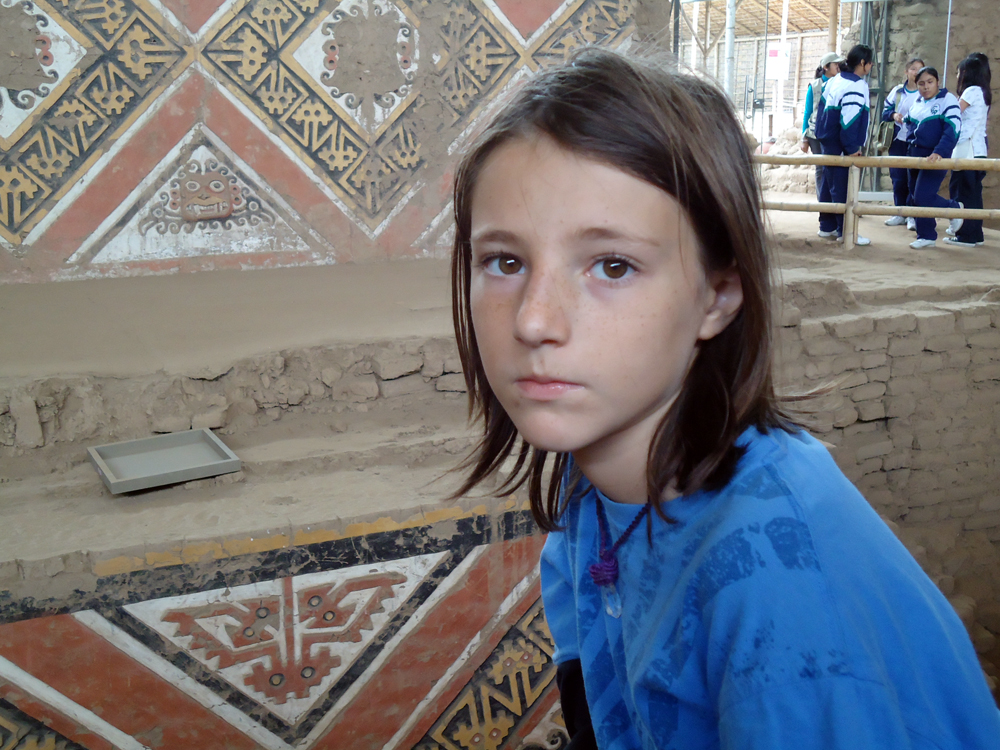
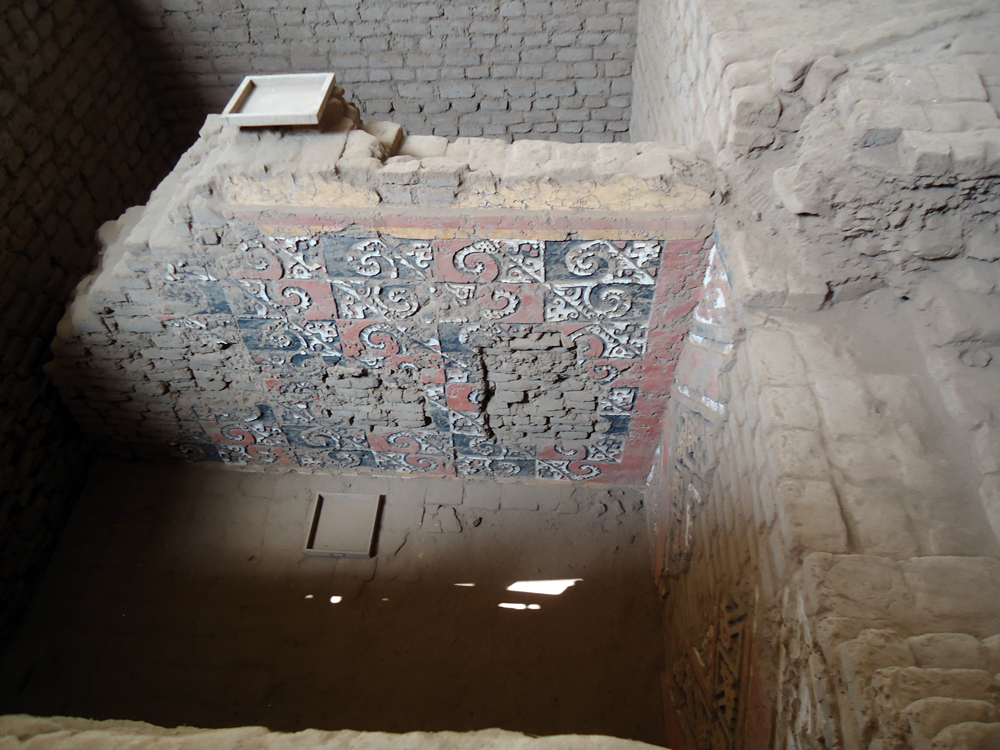
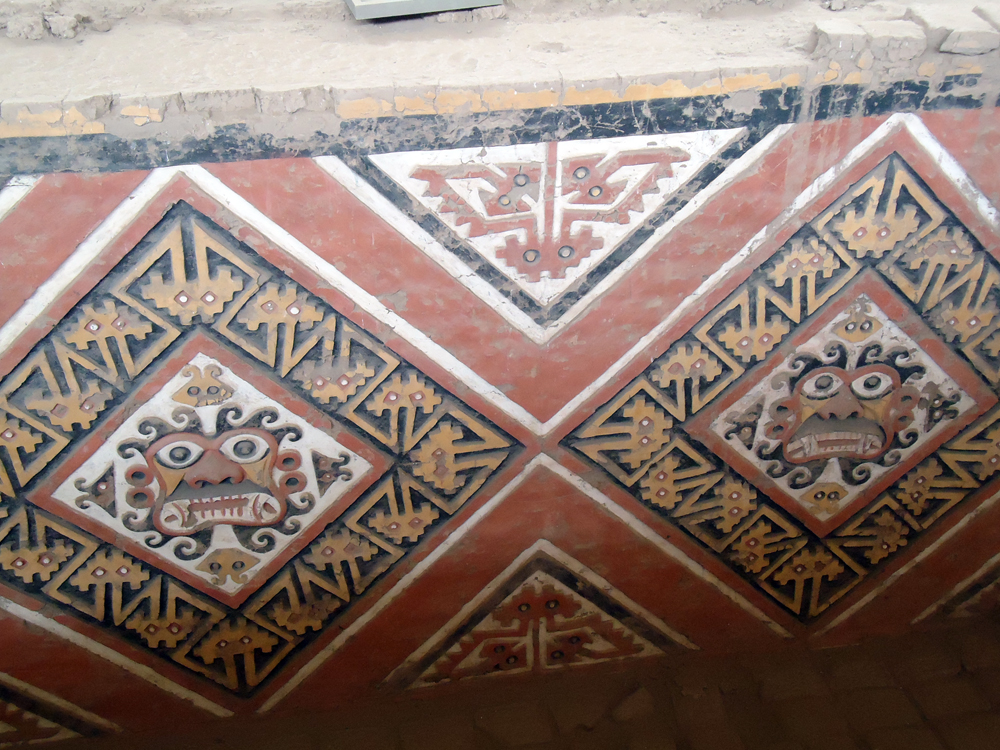
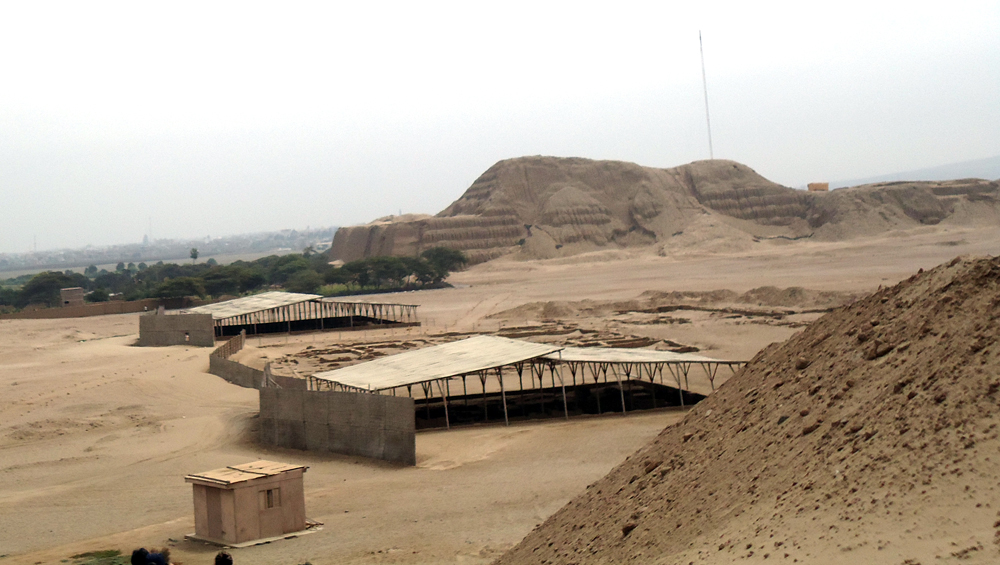
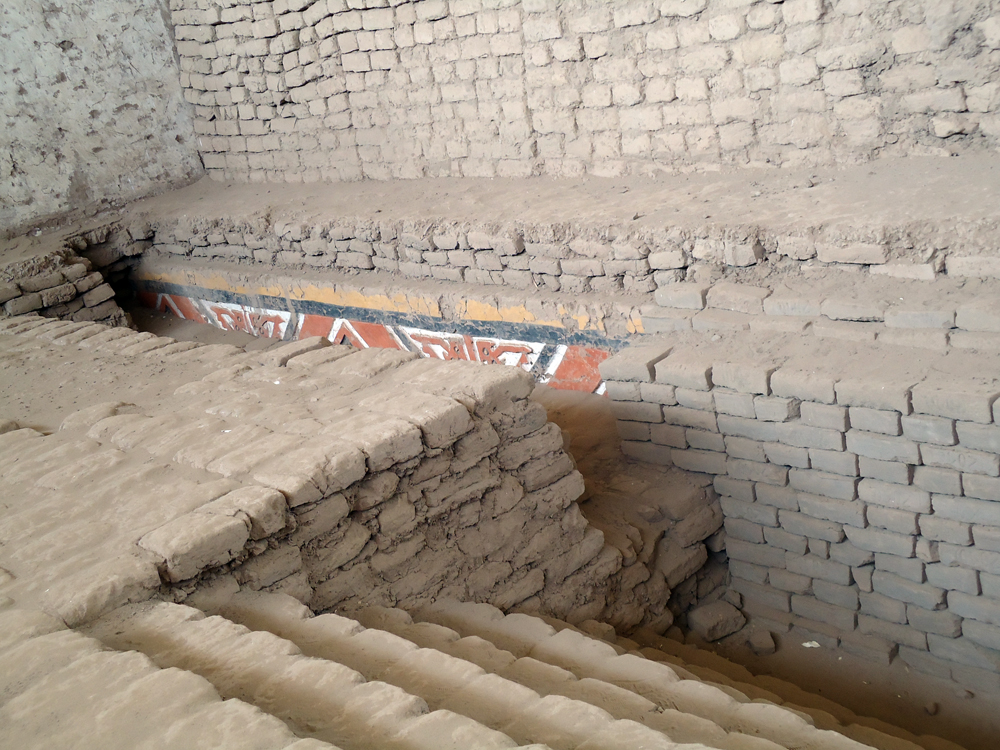
We visited the Temples of the Sun and Moon, which are both on the same site. However only the Temple of the Moon is open for visitors. Restoration of the Temple of the Moon began in 1991 and the site was opened to visitors in 1995, while restoration of the Temple of the Sun began earlier this year, in 2011. On site, a beautiful museum filled with Moche culture is located near the entrance of the Temple of the Moon.

This site is located just east of a prominent, freestanding hill, the Cerro Blanco (White Mountain), and next to a small tributary of the Moche River. The complex sits about three miles inland, southeast of the modern city of Trujillo and is considered by many scholars to be the former capital of the Moche State

The archaeological site was built at the time of the Moche culture (100 BC-650 AD).
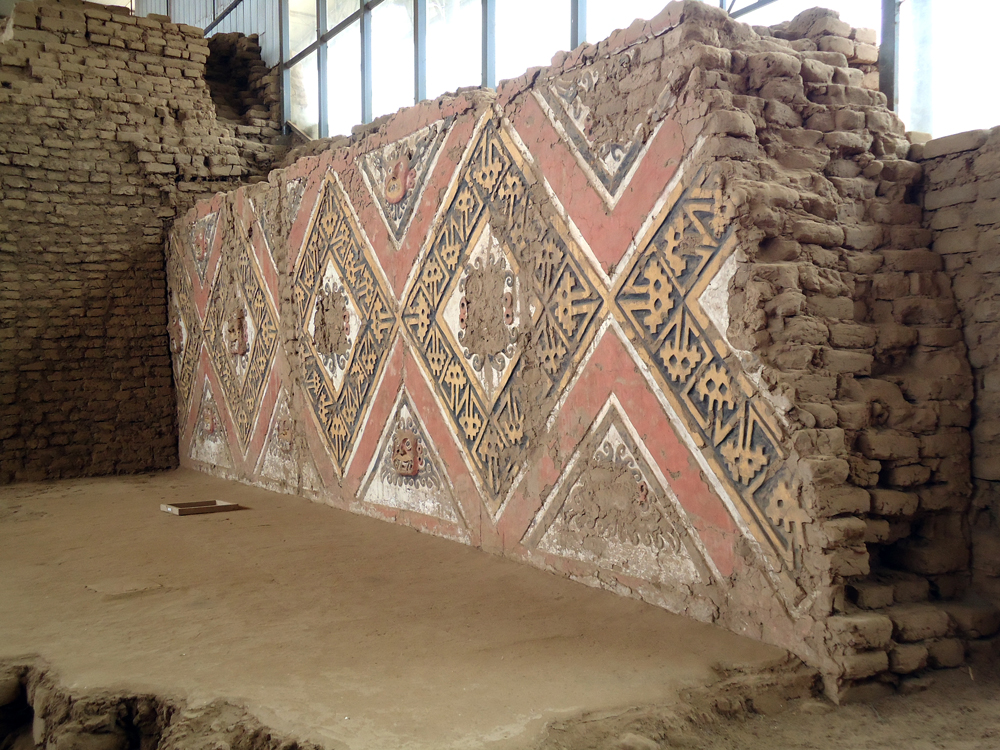
The Moches built the pyramids in levels and each level coincided with the rule of a particlaur emporor. Approximately every 100 years they would build a new pyramid on top of, completely encompassing the old pyramid. The old structure would be filled with adobe bricks and plastered to create a solid sealed structure to create a foundation for the new level. As a result, archaeologists began excavation of the site some 20 years ago, by a process of peeling back layers, layer by layer. Each layer revealed is own preserved original works of art, tombs, ceramics, and other ornaments.

I found this wonderful description of the both temples from this site:

Huaca del Sol (Temple of the Sun)

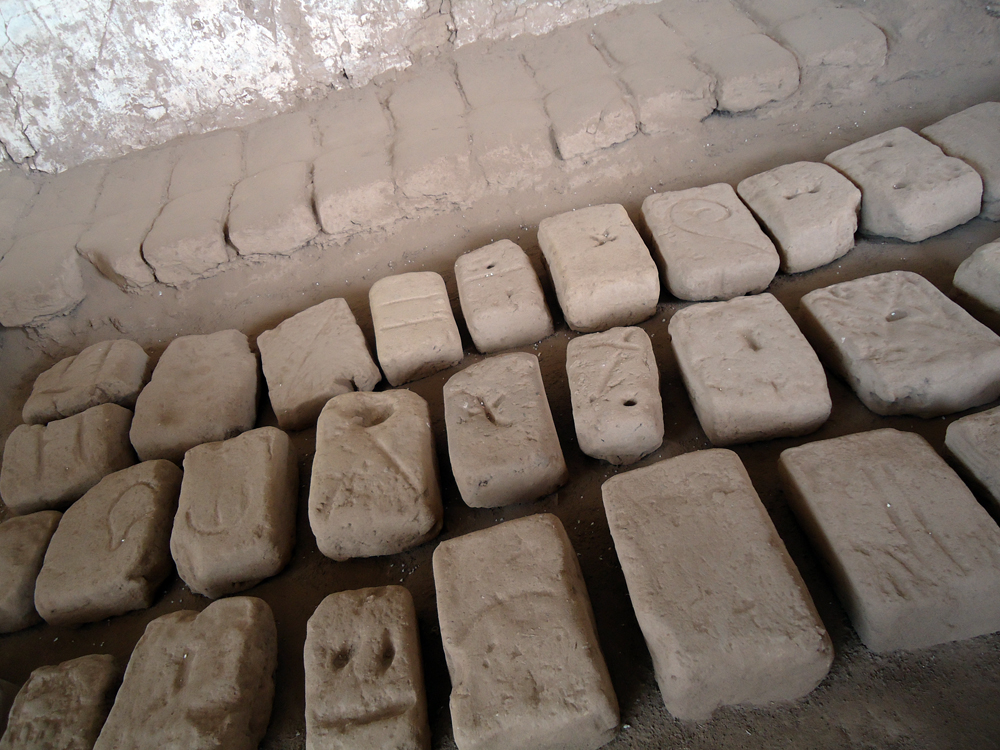
The stepped pyramid called Huaca del Sol measures 1,250 feet in length and towers 135 feet above the surrounding plain – this makes it the tallest adobe structure of the Americas. A calculated 50 million sun-dried, mud bricks, were used for its construction. This stepped pyramid is made up of four major platforms that rise from the northeast. The sections, or panels, in which the bricks were laid are clearly visible in the badly eroded eastern side. Many of the adobes have their original marks, such as imprints of hands, feet, dots, crosses, etc. These marks have been interpreted by researchers as accounting tools to distinguish different groups of brick manufacturers, which thus facilitated tracking the payment of “taxes”.
Huaca de la Luna
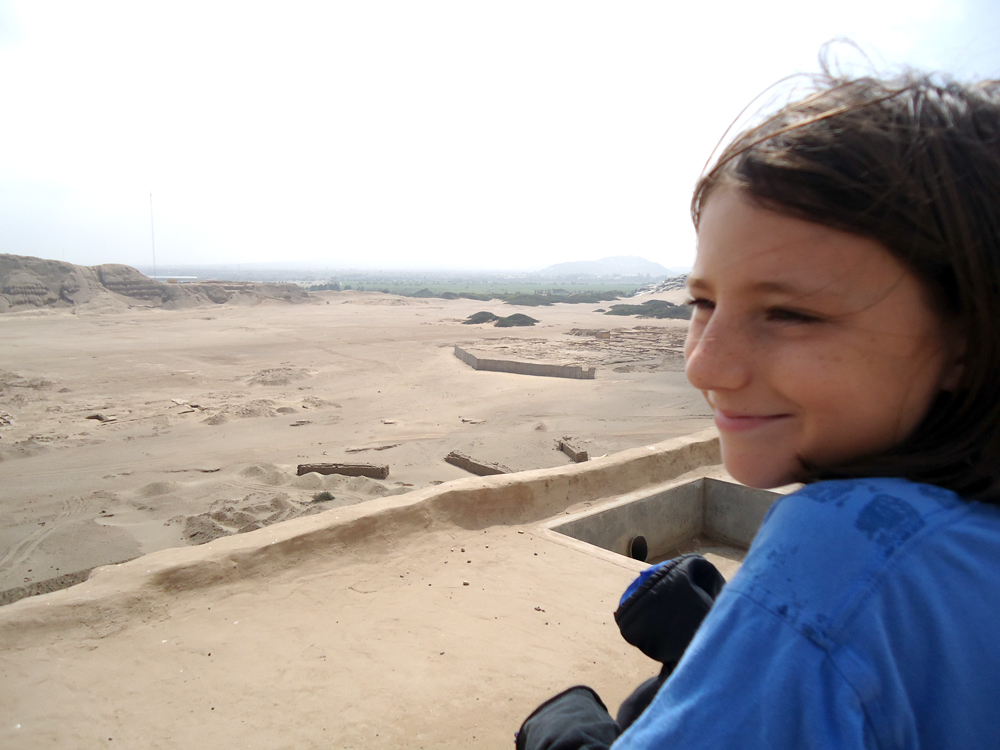
Beyond the Pyramid of the Sun lies the Temple of the Moon. Three platforms and four open courts or plazas take up most of the assemblage, which is built up against the lower slopes of the Cerro Blanco, (White Mountain). Overall, the site measures 950 feet from north to south and 690 feet from east to west. The access to the structure was probably located on the north side, which has been badly damaged by looting. Many Moche burials, some probably dedicatory but others as late as Chimú (about 1100-1470 AD), have been excavated inside the otherwise massive adobe platform and have yielded
Large-scale human sacrifice at Huaca de la Luna became evident when archaeologists uncovered the remains of at least 34 sacrificed adult male individuals in the soft clay of the southeastern court at the foot of the mountain. They had been bound and, judging by the type of wounds that had been inflicted, were probably captured in battle. The sacrifice represents a single ritual event linked by archaeologist Steve Bourget to a season of torrential rains caused by an extreme case of the maritime El Niño phenomenon, which strikes the coast of South America at irregular intervals and which may have caused the final abandonment of this site.

More from Wikipedia on the Moche culture:

About the Moche

Sacrifice!
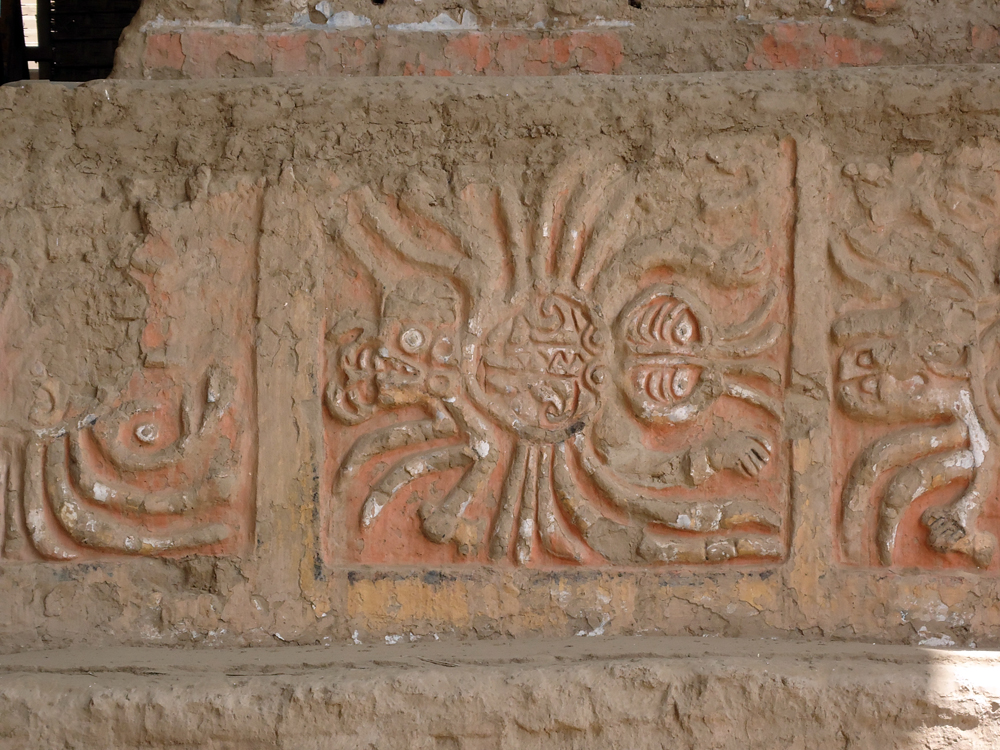
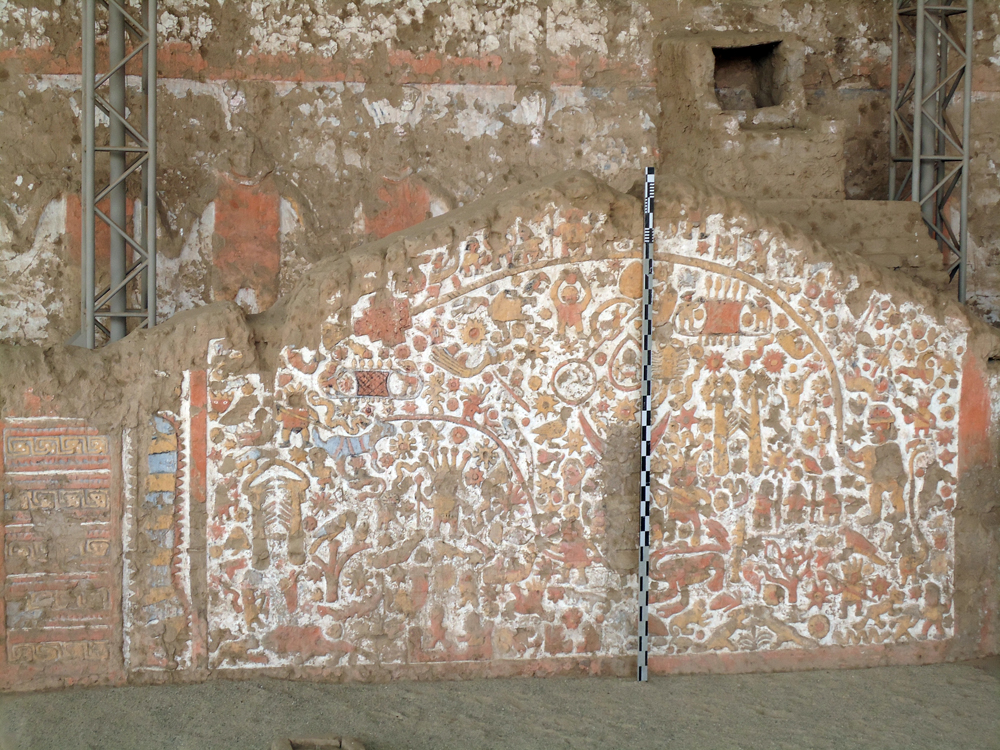
Both iconography and the finds of human skeletons in ritual contexts seem to indicate that human sacrifice played a significant part in Moche religious practices. These rites appear to have involved the elite as key actors in a spectacle of costumed participants, monumental settings and possibly the ritual consumption of blood. While some scholars argue that the sacrificial victims were the losers of ritual battles among local elites, others, suggest that the sacrificial victims were warriors captured in territorial battles between the Moche and other nearby societies. Excavations in plazas near Moche huacas have found groups of people sacrificed together and the skeletons of young men deliberately excoriated, perhaps for temple displays.
The Moche may have also held and tortured the victims for several weeks before sacrificing them, with the intent of deliberately drawing blood. Some believe that some parts of the victim may have been eaten as well in ritual cannibalism. The sacrifices may have been associated with rites of ancestral renewal and agricultural fertility. Moche iconography features a figure which scholars have nicknamed the “Decapitator”, frequently depicted as a spider, but sometimes as a winged creature or a sea monster. together all three features symbolize land, water and air. When the body is included, the figure is usually shown with one arm holding a knife and another holding a severed head by the hair. The “Decapitator” is thought to have figured prominently in the beliefs surrounding the practice of sacrifice
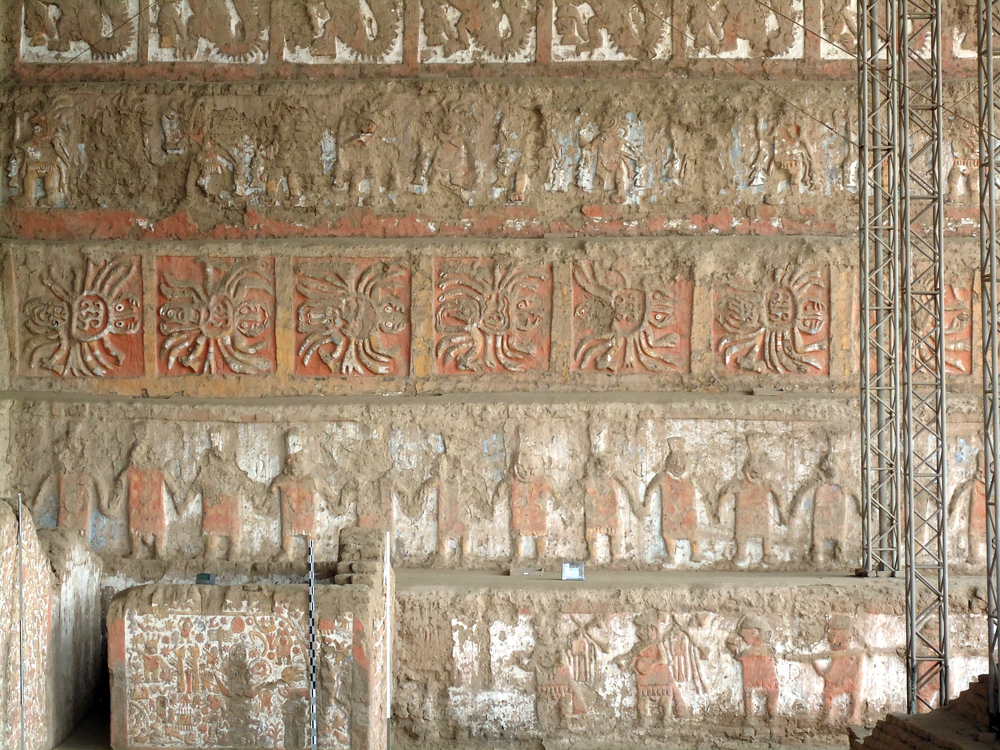
The Chimu culture proceeded the Moche culture. Be sure to check out our post on our visit to Chan Chan, just 25 minutes down the road from this site.

About the Author:

Lainie and her son Miro are living a location independent lifestyle, slow traveling around the globe and living in the present moment. Lainie writes about staying inspired, participating as a global citizen, volunteering, unschooling and natural learning. Guiding their experiences is the empowered choice to experience in the world without fear.

Lainie Liberti – who has written 409 posts on Raising Miro on the Road of Life - Travel Podcast.


Email • Facebook  • Twitter • YouTube • LinkedIn

7 Comments »

  • Raising Miro on the Road of Life – Travel Podcast » Blog Archive » Reflections of Time – Looking back on 2011 said:

    [...] One of the Most Interesting Cultural Destinations of 2011 [...]

    # 31 December 2011 at 10:58 am
  • Raising Miro on the Road of Life – Travel Podcast » Blog Archive » Discover the Magical El Brujo – The Tattooed Mummy of Cao said:

    [...] Although there were other religious and administrative centres in and around the valley  like the Temple of the Sun and the Moon near Trujillo, this particular complex stood out. The other minor centres were constructed to [...]

    # 2 February 2012 at 6:53 am
  • Raising Miro on the Road of Life – Travel Podcast » Blog Archive » Trujillo as a Destination said:

    [...] Pre-Columbian city which was designated a World Heritage Site by UNESCO. Also near Trujillo are the Sun and Moon temples, one of which is Peru’s largest adobe pyramid. In Trujillo itself, the city’s historic [...]

    # 17 February 2012 at 1:54 am
  • Podcast Episode #29 – Teen Talk + Peru Review | Raising Miro on the Road of Life - Travel Podcast said:

    [...] learned about so many cultures here, including the Moche, Chimu, Wari, Lambayaque, Paracas, Nasca and Chavin. Some of these cultures date back 3000 to 4000 [...]

    # 21 March 2012 at 2:17 pm
  • They Say The Moche Made A Warrior's Promise | Raising Miro on the Road of Life - Travel Podcast said:

    [...] well known for their pottery, gold work and ruins left behind. Miro and I were blessed to visit the Huaca de la Luna and Sol (temple of the Sun and Moon), which has remained largely intact with its many colorful murals with [...]

    # 27 July 2012 at 12:13 pm
  • The Archaeological & Historical Significance of Peru's Trujillo | We Blog The World said:

    [...] Pre-Columbian city which was designated a World Heritage Site by UNESCO. Also near Trujillo are the Sun and Moon temples, one of which is Peru’s largest adobe pyramid. In Trujillo itself, the city’s historic center [...]

    # 3 August 2012 at 3:58 pm
  • My adult 'unschooling' through Archeology | Raising Miro on the Road of Life - Travel Podcast said:

    [...] the ruins of the Mayans, Toltecs, Aztecs and Olmecs in Mexico and Guatemala,  and later the Moche, Moche, Chimu, Inca, Paracas, Nazca, Wari, Chincha cultures. With each new culture, I felt a deep [...]

    # 5 September 2012 at 6:21 pm

Leave your response!

Add your comment below, or trackback from your own site. You can also subscribe to these comments via RSS.

Be nice. Keep it clean. Stay on topic. No spam.

You can use these tags:
<a href="" title=""> <abbr title=""> <acronym title=""> <b> <blockquote cite=""> <cite> <code> <del datetime=""> <em> <i> <q cite=""> <strike> <strong>

This is a Gravatar-enabled weblog. To get your own globally-recognized-avatar, please register at Gravatar.

Click to cancel reply

welcome to RaisingMiro.com

lainie and miroA single mom & son's travel blog & podcast, chronicling their nomadic adventures as they travel around the world together; Raising Miro on the Road of Life.

Miro & Lainie (mother 46 and 13 year old son) share their adventures from the Road of Life, discussing issues of humanity, global citizenship, unschooling, slow travel, family travel, volunteering, travel inspiration & living in the moment as they explore the big beautiful planet, they call home.

Three and half years, 12 countries and many personal changes later, Lainie & Miro continue to slow travel around the globe, living an inspired possession-free-lifestyle, volunteering and learning naturally. They are following their interests on the road, as the planet has been transformed into their classroom. Often you will hear Lainie say “we are blessed to be accidental unschoolers” and has become and an advocate for “life learning” at any age. Lainie & Miro describe their greatest accomplishment as the ability to participate in the world without fear.

Connect with Us!

get social youtube twitter facebook flkr linkedin rss itunes
Newsletter Sign Up

Project Unschool Peru

♥ ♥ ♥ ♥ ♥ ♥ ♥ ♥ ♥ ♥ ♥ ♥ ♥ ♥ ♥ ♥ ♥ ♥ ♥ ♥ ♥ ♥ ♥ ♥ ♥

support our travels

Your Support Means the World to Us!

We are so grateful to you, our audience for taking this journey along with us. If you are inspired to support us with a donation, please know it goes a long way in keeping us safe + secure in the world. We pay it forward everyday and are grateful for each experience that comes our way.

As always we offer much love + light!

Sponsor Our Travels


Other Amount:


Raising Miro on the Road of Life :


Become a Facebook Fan!

Recents Gems

How do we earn a living?

How do we earn a living?

June 6th, 2013

We've been asked this question quite often as of late, and I realize we've never written a post addr[...]

New York - A Day in Pictures [PHOTO ESSAY]

New York - A Day in Pictures [PHOTO ESSAY]

June 7th, 2013

Unfortunately our time in New York was so brief.  During our 38 hours there, I remained in bed fight[...]

Families on the Move - Meet the Van Waardenburg Family

Families on the Move - Meet the Van Waardenburg Family

May 31st, 2013

Families on the Move We have been blessed to connect with many amazing families online, all of wh[...]

The day I picked up a rock to defend myself

The day I picked up a rock to defend myself

June 10th, 2013

Never in my life have I experienced a physical threat. I did not know what that feels like to have a[...]

Unschooling as an Alternative-The De-humanizing Aspects of Education

Unschooling as an Alternative-The De-humanizing Aspects of Education

June 17th, 2013

I have become a supporter for the practice of unschooling and believe wholeheartedly in the virtues [...]

Measuring Time Through Friendships- A New York Story

Measuring Time Through Friendships- A New York Story

June 1st, 2013

Sweet Friendships Robert was my partner for my baby care class in early 1999 before Miro was born. [...]

Interview with Documentary Filmmaker Seti Gershberg [VIDEO]

Interview with Documentary Filmmaker Seti Gershberg [VIDEO]

June 11th, 2013

Shamanism, ancient wisdom, and sacred plants On a beautiful Cusquenian morning, I was honored to si[...]

The End of the Road: Lies, Inauthenticity & Depression

The End of the Road: Lies, Inauthenticity & Depression

June 15th, 2013

The Long and Winding Road – The Conclusion ( Part one of this post called The Long and Winding Road[...]

Holy Water, Corn Beer, or Blood? The Mystery that Surrounds the Qenqo Temple

Holy Water, Corn Beer, or Blood? The Mystery that Surrounds the Qenqo Temple

June 19th, 2013

Qenqo If you are planning on visiting the historical sites around the Cusco Region in Peru, one thi[...]

Families on the Move - Meet the Family Behind Where'sSharon.com

Families on the Move - Meet the Family Behind Where'sSharon.com

June 14th, 2013

Families on the Move We have been blessed to connect with many amazing families online, all of wh[...]

The Mystery of Sayhuite

The Mystery of Sayhuite

June 3rd, 2013

Another of Peru's greatest anomalies: The mysterious site of Sayhuite, is one of Peru's greatest an[...]

Visiting the The Museum of Science in Boston [PHOTO ESSAY]

Visiting the The Museum of Science in Boston [PHOTO ESSAY]

June 5th, 2013

One of the greatest of all educational museums in Boston is no other than the Boston Science Museum.[...]

Archives

Categories


we can help

travel calendar       JetRadar

ReThinking Everything Unschooling Conference
   

More Great Links


Project Unschool Peru

Interest-Led Learning in Perú - Inspiring A Temporary Learning Community

ilainie - photo project


jungle[8]

My former branding & graphic design agency.


Image Licensing


You may alter, reuse, and share my images for NON COMMERCIAL PURPOSES as long as you provide attribution to "Raising Miro on the Road of Life" with a link to http://www.raisingmiro.com or to the original author as indicated.

creative commons license

RaisingMiro Links

the basics

Home
Contact
Donate Us
Press
Advertise
Policies


the specifics

Unschooling
Global Citizenship
Slow Travel
In the Moment
Family Travel
Volunteering
Travel Inspiration
Archeology
Cultural Experiences
Photo Essays
Podcasts
Video


get social

youtube
twitter
facebook
flickr
linkedin
rss
itunes

Ask Us Anything – We Answer your Questions


Got Questions for us?


Get in Touch Today

Podcast powered by podPress v8.8.10.17